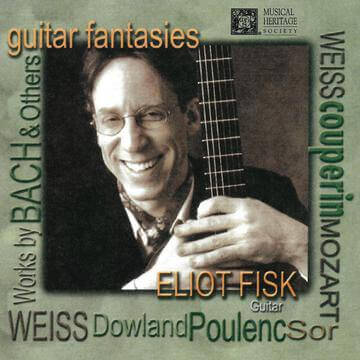
One of the principal advantages of being a musician in the 20th century is the opportunity to experience in one lifetime the music of many epochs. In Guitar Fantasies I move back and forth in time, playing with a few of the possibilities suggested by the work of widely differing musical personalities. I've always loved Luis Milan's definition of the fantasia contained in his El maestro, published in Valencia in 1535 or 1536. “Any work in this book ... may be called fantasia in the sense that it only comes from the fantasy and hard work of the author." Indeed, I've sometimes used this definition (or lack of one!) in selecting the pieces heard here. I use the number three as a kind of ordering principle. This idea comes from the three Tentos by Hans Werner Henze (although Maestro Henze is of course innocent of any and all transgressions I may have committed!). Thus, in the first group of fantasies Papa Bach and his son Carl Philipp Emanuel frame one of Couperin's unforgettable harpsichord masterpieces. Three pieces by the superb baroque lutenist Weiss follow. This structure is mirrored at the end of the recording by the Tentos and pieces by Roussel, Poulenc, and, finally, as a kind of closing encore, Barrios. In between come six (3 + 3) fantasies by various masters of the Renaissance and early baroque followed by two short pieces by Mozart, which frame Sor's Variations on a theme from Die Zauberflote.